For patients asking whether they can undergo a hair transplant while living with obesity, a structured assessment is the first step toward understanding their treatment options and the preparations required before making an informed decision.
What Is Obesity, and How Can It Affect Hair Health?
Obesity is a complex, progressive chronic disease characterized by excessive adipose tissue accumulation that may adversely affect health and quality of life. Globally, the number of adults living with obesity has more than doubled since 1990. Obesity may shorten life expectancy through its association with type 2 diabetes mellitus, cardiovascular disease (including myocardial infarction, hypertension, and stroke), metabolic dysfunction–associated steatotic liver disease, musculoskeletal disorders, chronic respiratory disease, depression, and certain cancers. However, not every person with obesity develops these conditions. Total fat mass alone does not adequately explain the risk of obesity-related complications. Abdominal fat accumulation, adipocyte enlargement, and increased immune-cell infiltration of adipose tissue are important features that can affect the brain, liver, vasculature, and other organs. Genetic and environmental factors contribute to adipose tissue dysfunction. Weight reduction through behavioral interventions, pharmacotherapy, or bariatric surgery may improve health and quality of life and reduce the risk of obesity-related disease.
Diagnosis and Clinical Assessment of Obesity
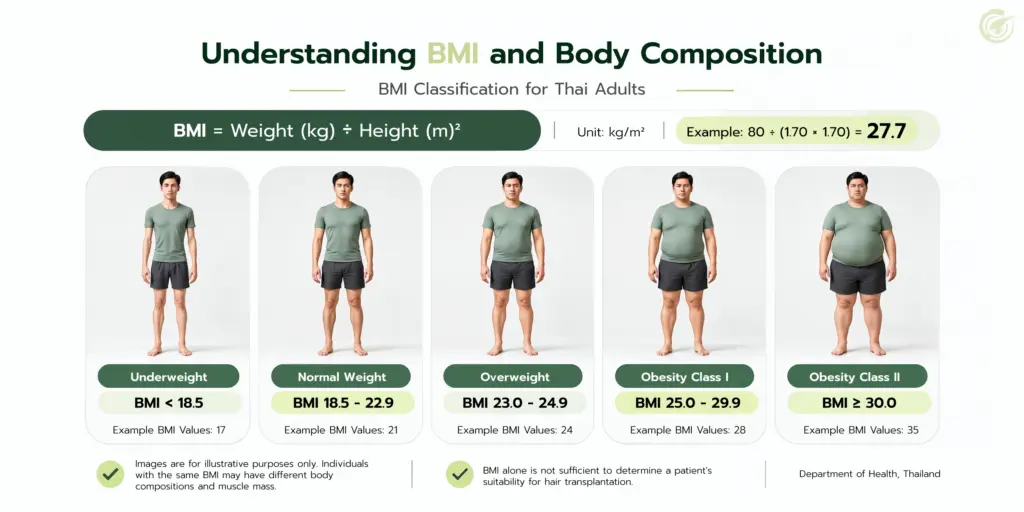
Obesity has traditionally been classified using a BMI of 30 kg/m² or higher in the general adult population, with lower thresholds commonly used for Asian populations, including 25 kg/m². BMI is calculated as body weight in kilograms divided by height in meters squared. Nevertheless, BMI does not directly measure body-fat distribution, muscle mass, or an individual’s overall health risk.
The European Association for the Study of Obesity (EASO) has proposed an integrated framework for the diagnosis, staging, and management of obesity in adults, reflecting its recognition as a chronic disease involving excess adiposity. The framework emphasizes the importance of abdominal fat accumulation as a determinant of cardiometabolic complications, including in individuals whose BMI falls within the normal-weight or overweight range.
Beyond body weight, BMI, and measures of fat distribution, clinical assessment should systematically consider other manifestations of obesity, including functional limitations and psychological health.
Some studies have identified an association between higher BMI and more severe androgenetic alopecia. However, an observed association does not establish that obesity directly causes hair loss or that weight reduction will restore hair density in every patient.
Patients presenting with hair thinning should first undergo an appropriate diagnostic assessment to distinguish androgenetic alopecia, telogen effluvium, scalp disorders, and other causes. Hair transplantation is suitable for selected conditions, but it is not the first-line treatment for every type of hair loss.
Can Patients With Obesity Undergo Hair Transplantation? What Should Be Evaluated Before Surgery?
Obesity alone is not an absolute contraindication to hair transplantation. The International Society of Hair Restoration Surgery (ISHRS) identifies obesity among the health-related risk factors that should be disclosed before hair restoration surgery, alongside diabetes, smoking, and cardiovascular disease. The presence of a risk factor calls for additional assessment and planning; it does not automatically exclude treatment.
Patients whose obesity-related conditions are adequately controlled, who can safely tolerate the positioning required during surgery, and who have an adequate supply of healthy donor hair may be candidates for transplantation. By contrast, patients with unstable comorbidities, respiratory difficulties, or an inability to tolerate prone positioning may require medical optimization, procedural modifications, or care in a facility equipped to manage their specific risks. BMI should not be treated as a universal pass–fail threshold for hair transplantation; the cited sources do not establish a single BMI cutoff applicable to every patient.
For example, the UK National Institute for Health and Care Excellence (NICE) recommends lower BMI thresholds when assessing health risks in people from certain Asian backgrounds. A BMI of 23.0–27.4 kg/m² is within the overweight range under this approach, while a BMI of 27.5 kg/m² or higher is used as an obesity threshold. These thresholds support risk assessment but do not, by themselves, establish that a particular individual has additional health complications.
Consequently, two patients with identical BMI values may require different hair transplantation plans because of differences in comorbidities, sleep-related breathing disorders, medications, and overall procedural fitness.

Why Does Obesity Matter in Hair Transplantation?
Obesity may coexist with clinically significant conditions such as diabetes, hypertension, cardiovascular disease, and gastroesophageal reflux. Each can influence preoperative preparation, medication selection, and monitoring during the procedure. A complete medical history and medication review are therefore essential before treatment planning.
A systematic review published in 2024 reported associations between metabolic syndrome and postoperative complications, including infection and impaired wound healing. Metabolic syndrome commonly coexists with obesity, although the two conditions are not interchangeable.
Obstructive sleep apnea (OSA) is more prevalent among individuals with obesity and warrants particular attention when sedatives, hypnotics, or anesthetic agents are considered, because these medications may adversely affect ventilation and airway patency.
Although hair transplantation is generally performed under local anesthesia, the use of additional medications varies between patients. Individuals who snore loudly, have witnessed breathing pauses during sleep, experience excessive daytime sleepiness, or use continuous positive airway pressure (CPAP) should inform their treating physician. Further screening or adjustments to the perioperative care plan may be appropriate.
Practical planning should also assess whether the patient can comfortably remain prone or seated for the duration of each procedural stage, whether breathing remains comfortable in those positions, and whether neck or back pain or the dimensions of the operating chair or bed create limitations. Where necessary, the team may modify positioning, procedural duration, or the treatment approach to improve safety and tolerability.

Does Weight Loss Affect Hair Health, and Must Patients Lose Weight Before Transplantation?
Rapid weight reduction may trigger telogen effluvium, a form of diffuse hair shedding. A study published in 2024 described telogen effluvium associated with weight loss and documented recovery during follow-up, although the course varied between individuals.
When shedding develops after substantial dietary restriction, bariatric surgery, or the initiation of a weight-management program, assessment should include the timing of hair loss, changes in body weight, nutritional status, and, where indicated, laboratory testing for deficiencies. Many such patients do not require hair transplantation.
Weight loss is not invariably required before hair transplantation if the patient has no uncontrolled or clinically significant obesity-related complications. Nevertheless, improving metabolic health and reducing relevant procedural risks may be advisable. Because hair transplantation is elective, the physician may recommend medical optimization or weight management before proceeding in higher-risk cases.
Patients should not undertake crash diets or prolonged fasting simply to meet a scheduled procedure date. Rapid weight loss may disrupt the hair cycle. The priority should be stable health, adequate nutrition, and a sustainable treatment plan.

Can Patients Undergoing Pharmacological Weight Management Have a Hair Transplant?
Patients taking weight-management medications such as semaglutide or tirzepatide should disclose the drug name, dose, date of the most recent administration, and any gastrointestinal symptoms. Glucagon-like peptide-1 (GLP-1)-based therapies may delay gastric emptying, an important consideration particularly when deep sedation or general anesthesia is planned.
These medications do not necessarily need to be discontinued before hair transplantation, and treatment may often continue afterward. However, patients should not independently stop medication, extend dosing intervals, or fast before the procedure. The procedural physician and prescribing clinician should determine an individualized plan based on dose escalation, nausea, vomiting, abdominal bloating, comorbidities, and the proposed anesthetic technique.
Hair and Scalp Assessment With FollicleForge AI at BEQ Hair Clinic
Readiness for hair transplantation depends on both general health and the condition of the scalp and hair. At BEQ Hair Clinic, FollicleForge AI is used as an adjunct to scalp assessment, hair-density analysis, and donor-area evaluation. The system may assist in estimating graft requirements, visualizing potential outcomes, and supporting individualized treatment planning.
For patients living with obesity, these findings can facilitate discussions about the pattern of hair thinning, the recipient areas requiring attention, and donor-hair availability. The physician must interpret the results alongside the patient’s medical history, clinical scalp examination, and underlying diagnosis.

Follicular Unit Excision (FUE) or Direct Hair Implantation (DHI): Which Is More Suitable for Patients With Obesity?
Follicular unit excision (FUE) refers to the extraction of follicular units individually, whereas Direct Hair Implantation (DHI) generally describes implantation using an implanter device. Neither approach is inherently specific to, or universally preferable for, patients with obesity. Technique selection should be based primarily on the hair-loss diagnosis, surgical objectives, donor characteristics, and individual medical considerations. Either approach may be considered after a physician has evaluated the patient’s overall suitability for hair transplantation.
How Should Patients With Obesity Prepare for Hair Transplantation?
Before the consultation, patients should prepare the following information:
- Medical conditions, available health-screening results, and a complete medication list, including weight-loss medications, dietary supplements, and drugs that affect blood clotting.
- A history of snoring, witnessed apneic episodes, CPAP use, or breathing difficulties when lying down.
- Recent rapid weight changes, previous bariatric surgery, or substantial hair shedding.
- Positioning limitations, neck or back pain, drug allergies, and any previous adverse reactions to anesthesia or sedation.
Patients should obtain individualized advice about medication use, food and fluid intake, travel after treatment, and postoperative care. Unstable comorbidities should be appropriately managed before an elective procedure is undertaken.
After transplantation, patients should follow wound-care and medication instructions, continue managing their underlying medical conditions, and attend scheduled follow-up appointments. Increasing pain, swelling, purulent discharge, or other concerning symptoms warrant prompt medical evaluation.
Begin Your Hair Restoration Assessment at BEQ Hair Clinic
If you are living with overweight or obesity and are concerned about hair thinning, a clinical consultation can help determine whether medical therapy, scalp treatment, observation, or hair transplantation is the most appropriate next step.
At BEQ Hair Clinic, patients may consult a physician about their hair and scalp and ask whether FollicleForge AI assessment would be useful in developing a personalized treatment plan. Bringing an up-to-date medication list, details of existing medical conditions, and relevant health-screening results can support this assessment.
Hair transplantation carries risks, and outcomes vary between individuals. A physician must assess medical suitability and the cause of hair loss before the patient decides whether to proceed with treatment at BEQ Hair Clinic.
Frequently Asked Questions: Obesity and Hair Transplantation
Can I undergo hair transplantation if I weigh more than 100 kg?
Body weight alone is insufficient to determine eligibility. Height, comorbidities, respiratory status, procedural fitness, and hair and scalp characteristics must also be considered.
Does a high BMI mean transplanted grafts will not survive?
No such conclusion can be drawn from BMI alone. The evidence cited in this article does not establish a reliable graft-survival rate according to BMI category. Risk assessment should be individualized.
Should I tell my physician if I snore loudly but have never had a sleep study?
Yes. This is particularly important if you also experience daytime sleepiness or have witnessed breathing pauses during sleep. Your physician can determine whether further screening or testing is needed.
Must everyone stop injectable weight-loss medication before hair transplantation?
No. Management depends on the specific medication, gastrointestinal symptoms, and the planned anesthetic approach. Do not change your medication regimen without medical advice.
Can FollicleForge AI confirm that hair transplantation is medically safe for me?
No. The system supports hair assessment and treatment planning; medical fitness and procedural risks must be evaluated by a physician.
References:
- International Society of Hair Restoration Surgery. Hair Restoration Surgery Risk Factors.
- American Society of Anesthesiologists. Obesity & Anesthesia. Made for This Moment.
- National Institute for Health and Care Excellence. Overweight and obesity management. NICE guideline NG246. 2025. Section: Identifying and assessing overweight, obesity and central adiposity.
- Metabolic syndrome and surgical complications: a systematic review and meta-analysis of 13 million individuals. 2024.
- Higher body mass index is associated with greater severity of alopecia in men with male-pattern androgenetic alopecia in Taiwan: a cross-sectional study. PubMed
- Telogen Effluvium Associated With Weight Loss: A Single Center Retrospective Study. Annals of Dermatology.
- American Society of Anesthesiologists. Most Patients Can Continue Diabetes, Weight Loss GLP-1 Drugs Before Surgery, Those at Highest Risk for GI Problems Should Follow Liquid Diet Before Procedure.
- Oprea AD, et al. Perioperative management of patients taking glucagon-like peptide 1 receptor agonists: Society for Perioperative Assessment and Quality Improvement (SPAQI) multidisciplinary consensus statement. British Journal of Anaesthesia. 2025.
- BEQ Hair Clinic. FollicleForge AI.
If you are interested in a hair transplant, or if you have concerns regarding the health of your hair or scalp, please feel free to contact us for further information:
📞 094-441-4965
📩 Line: @beq_haircenter
Click: http://line.me/ti/p/@beq_haircenter
Facebook: BEQ Hair Center
Instagram: beqhaircenter_dr.danai
Instagram: beq_hairclinic
YouTube: BEQ Hair Center
TIKTOK: beq_hair_center