Traditional Chinese physiognomy (Mian Xiang) associates facial features with personality and life circumstances. These interpretations are cultural beliefs rather than evidence-based medical conclusions. There is no scientific basis for claiming that hairline alteration can improve wealth, career outcomes, or personal success.
In clinical hair restoration, the objective is a natural-looking, proportionate, age-appropriate hairline that remains aesthetically credible over time. A given contour may visually modify the perceived height or width of the forehead, but no single design suits every patient.
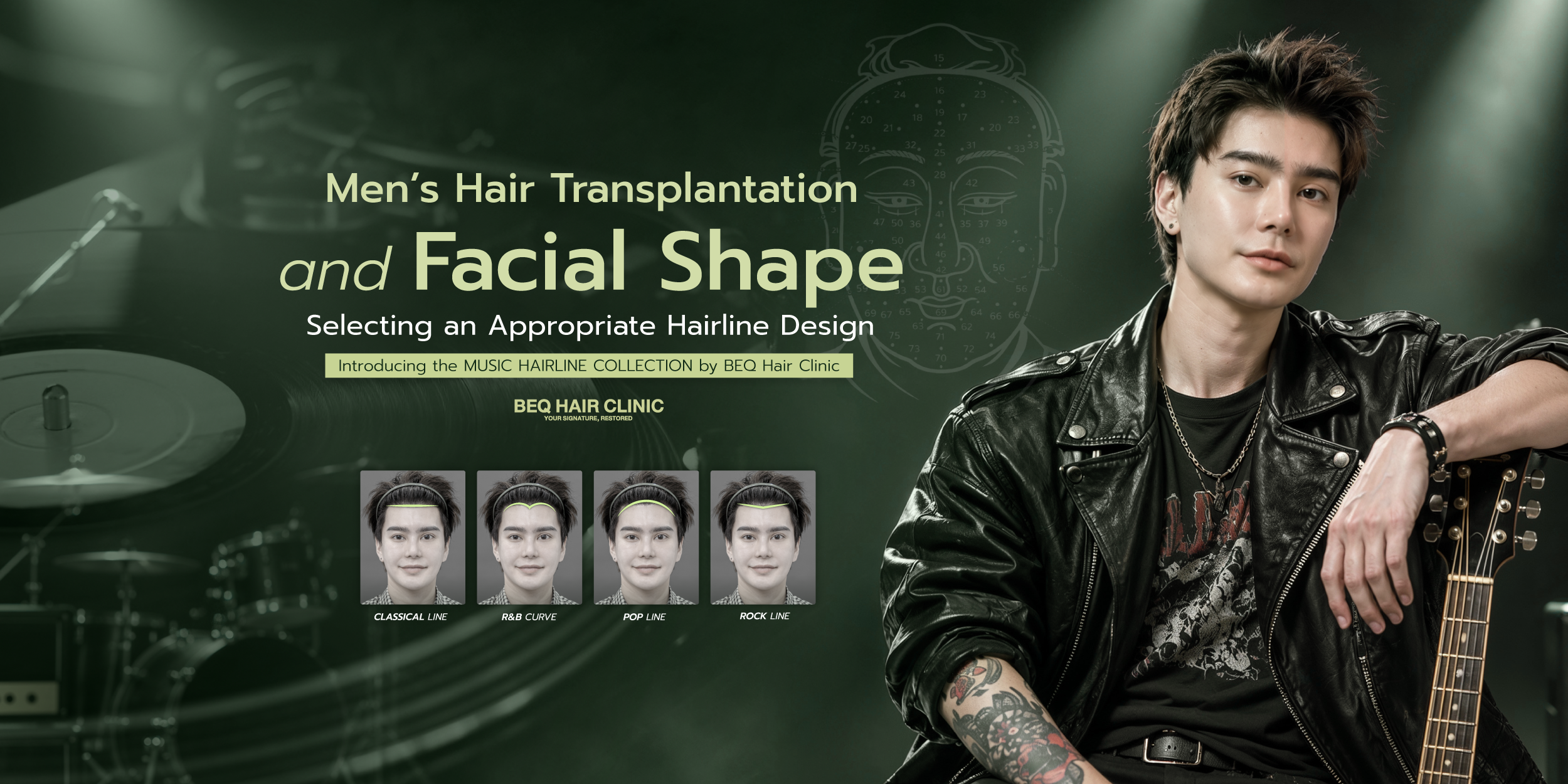
To help patients discuss aesthetic preferences, BEQ Hair Clinic developed the MUSIC HAIRLINE COLLECTION: seven creative design concepts inspired by CLASSICAL, R&B, POP, HIP-HOP, JAZZ, EDM, and ROCK. These labels are communication aids, not established medical classifications or substitutes for individualized assessment.
Before Choosing a Hairline: Assess Facial Proportions
Face shape and hairline shape are related but distinct. Facial morphology reflects underlying anatomical proportions, whereas the hairline may change with age, genetics, and androgenetic alopecia.
1. Frontal observation
Stand facing a mirror at eye level, without tilting the head, and expose the current frontal hairline.
2. Proportional assessment
Consider overall facial length, forehead width and height, cheekbone prominence, and mandibular contour.
3. Hairline assessment
Evaluate the existing frontal border and frontotemporal angles separately from the underlying facial shape.
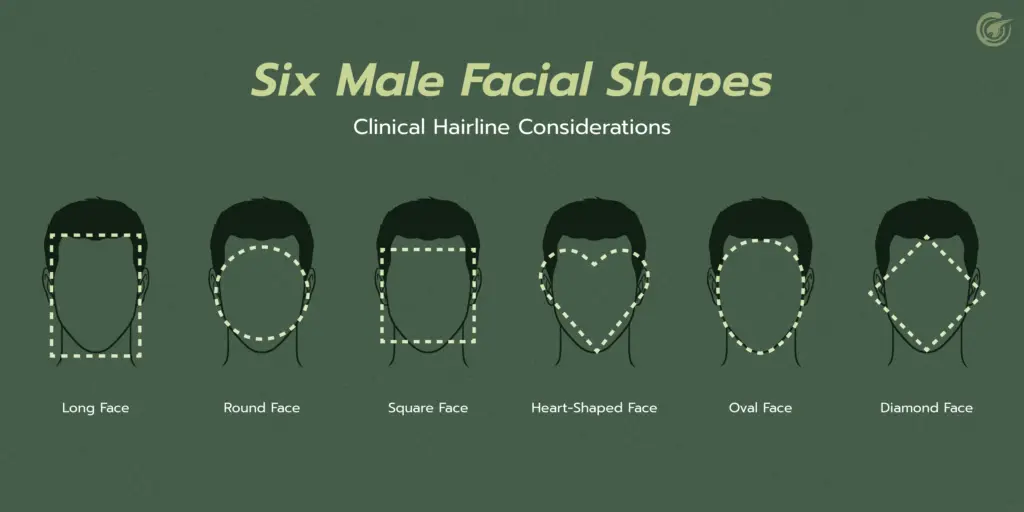
Six Male Facial Shapes: Clinical Hairline Considerations
1. Long Face
Facial morphology: Facial length is visibly greater than facial width; the forehead, midface, and jaw may have relatively similar widths.
Traditional physiognomy: Traditional physiognomy emphasizes proportional balance between the forehead and central face.
Hairline design considerations: In a patient with a relatively high forehead, a gently curved frontal contour may be considered to improve perceived balance. Lowering the hairline is not automatically indicated: forehead dimensions, existing hairline position, donor supply, and long-term stability remain important.
2. Round Face
Facial morphology: Facial width and length are relatively similar, with softer contours and a less angular jaw.
Traditional physiognomy: Traditional physiognomy sometimes associates rounded facial features with fullness and harmony.
Hairline design considerations: A more defined or relatively straight frontal contour may introduce visual structure. Excessively low placement can make the face appear shorter. A softer curve may be preferable when a less angular aesthetic is desired.
3. Square Face
Facial morphology: Forehead and jaw widths are often comparable, with a prominent mandibular angle.
Traditional physiognomy: Traditional physiognomy associates this morphology with strength and stability.
Hairline design considerations: An M-shaped contour or subtle frontotemporal recession may complement a more angular facial appearance. An overly straight, sharply delineated border can look artificial; appropriate irregularity and transitions are essential.
4. Heart-Shaped Face
Facial morphology: The upper face is wider than the lower face, tapering toward the chin.
Traditional physiognomy: Traditional interpretations emphasize balance between the forehead and lower face; they cannot predict intelligence, wealth, or financial stability.
Hairline design considerations: If frontotemporal recessions are prominent, a gently curved design may soften the overall appearance. The clinician should avoid making the upper face appear disproportionately wide or narrow.
5. Oval Face
Facial morphology: Facial length slightly exceeds width, with comparatively balanced forehead and jaw proportions.
Traditional physiognomy: Traditional physiognomy commonly describes this shape as harmonious.
Hairline design considerations: Several hairline contours may be aesthetically appropriate, including CLASSICAL-, R&B-, JAZZ-, or ROCK-inspired options. Selection should still reflect the patient’s natural anatomy and future hair-loss risk.
6. Diamond Face
Facial morphology: The cheekbones form the widest facial region, while the forehead and jaw are relatively narrow.
Traditional physiognomy: Traditional interpretations focus on the relationship between cheekbone width and forehead proportions.
Hairline design considerations: Forehead width and frontotemporal angles merit careful assessment. Filling every recessed area may produce an unnaturally low or overly dense-appearing border; selective preservation can be more balanced.
MUSIC HAIRLINE COLLECTION: Seven Design Concepts
Different hairline contours can convey different aesthetic impressions. The following names are proprietary creative descriptors used by BEQ Hair Clinic to facilitate discussions between patients and clinicians. They do not constitute a validated medical classification, and suitability cannot be determined by face shape alone.
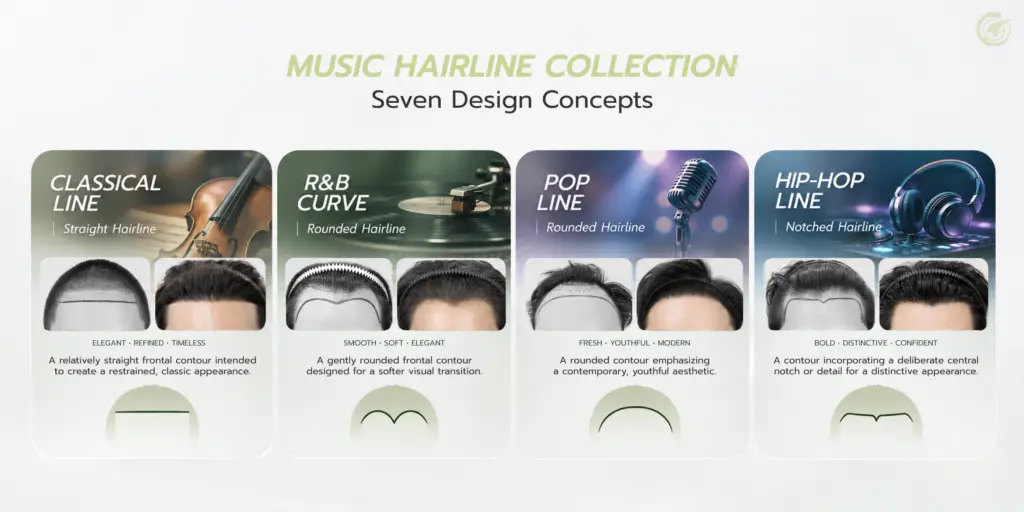
1. CLASSICAL LINE — Straight Hairline
Elegant • Refined • Timeless
A relatively straight frontal contour intended to create a restrained, classic appearance.
2. R&B CURVE — Rounded Hairline
Smooth • Soft • Elegant
A gently rounded frontal contour designed for a softer visual transition.
3. POP LINE — Rounded Hairline
Fresh • Youthful • Modern
A rounded contour emphasizing a contemporary, youthful aesthetic.
4. HIP-HOP LINE — Notched Hairline
Bold • Distinctive • Confident
A contour incorporating a deliberate central notch or detail for a distinctive appearance.
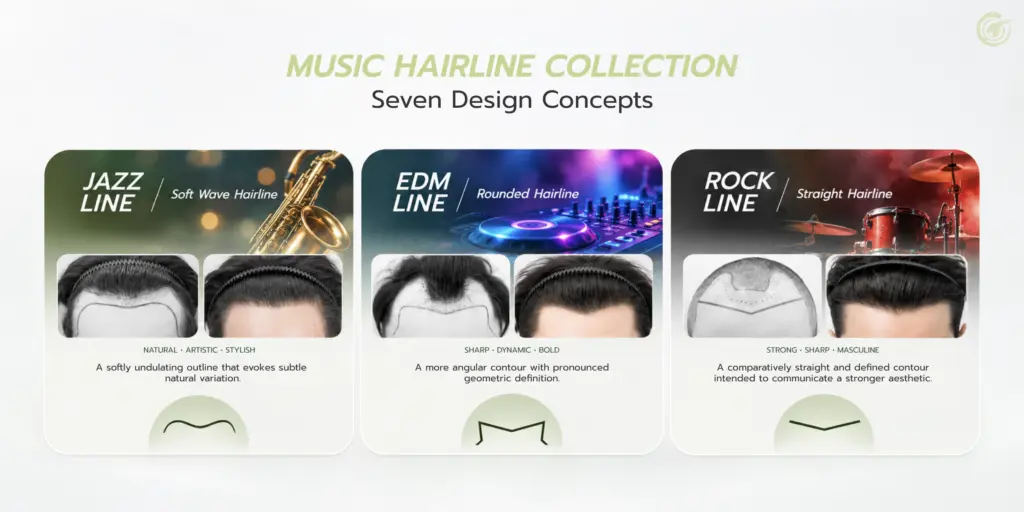
5. JAZZ LINE — Soft Wave Hairline
Natural • Artistic • Stylish
A softly undulating outline that evokes subtle natural variation.
6. EDM LINE — Angular Hairline
Sharp • Dynamic • Bold
A more angular contour with pronounced geometric definition.
7. ROCK LINE — Straight Hairline
Strong • Sharp • Masculine
A comparatively straight and defined contour intended to communicate a stronger aesthetic.
Personalized Hairline Design at BEQ Hair Clinic
A personalized surgical plan considers facial anthropometry, forehead height and width, frontal and temporal points, existing hairline configuration, age, hair calibre and curl, donor-area density and quality, and the likely course of androgenetic alopecia. The proposed design must also be technically feasible and compatible with long-term donor-hair conservation.
Some patients may benefit from preserving their current frontal position; others may be candidates for selective reinforcement or modification. An aesthetic preference alone does not establish medical suitability. Final planning requires direct assessment by the treating clinician and discussion of realistic expectations, limitations, and potential future hair loss.
The goal is not to reproduce another person’s hairline but to create a natural, proportionate result appropriate to the individual.
Discover Your Signature Hairline
In the next article, BEQ Hair Clinic will examine each of the seven MUSIC HAIRLINE COLLECTION styles in greater detail, including their visual characteristics and the clinical factors relevant to individualized selection.
The ideal hairline is not necessarily the lowest, straightest, or most fashionable. It is a design that harmonizes with facial anatomy, remains appropriate with age, and respects the patient’s long-term hair-restoration needs.
BEQ Hair Clinic | Hair Restoration and Personalized Hairline Design
If you’re considering a hair transplant to enhance your facial harmony, improve your appearance, or achieve a new look, feel free to contact us for more information:
📞 094-441-4965
📩 Line: @beq_haircenter
Click: http://line.me/ti/p/@beq_haircenter
Facebook: BEQ Hair Center
Instagram: beqhaircenter_dr.danai
Instagram: beq_hairclinic
YouTube: BEQ Hair Center
TIKTOK: beq_hair_center