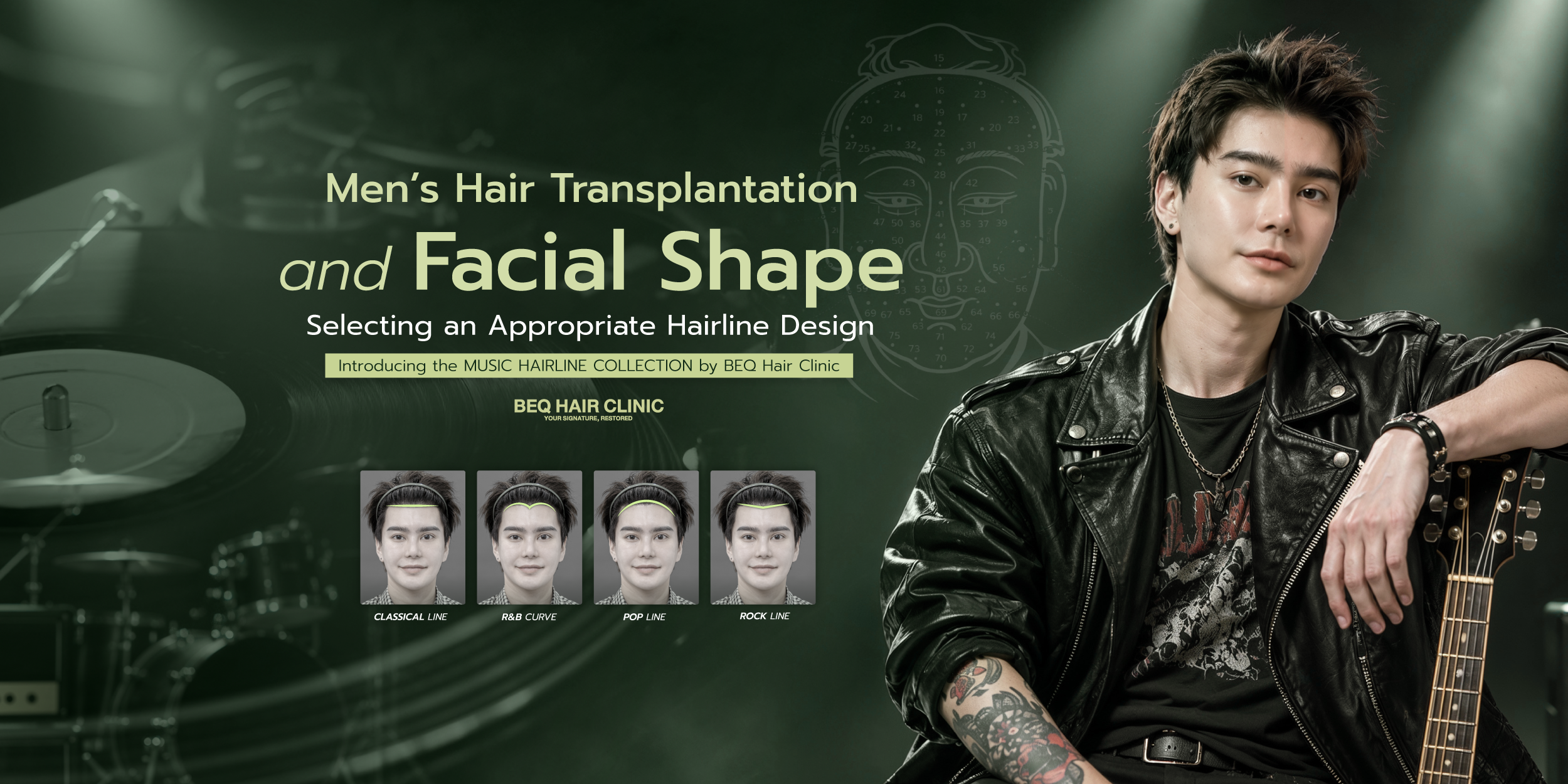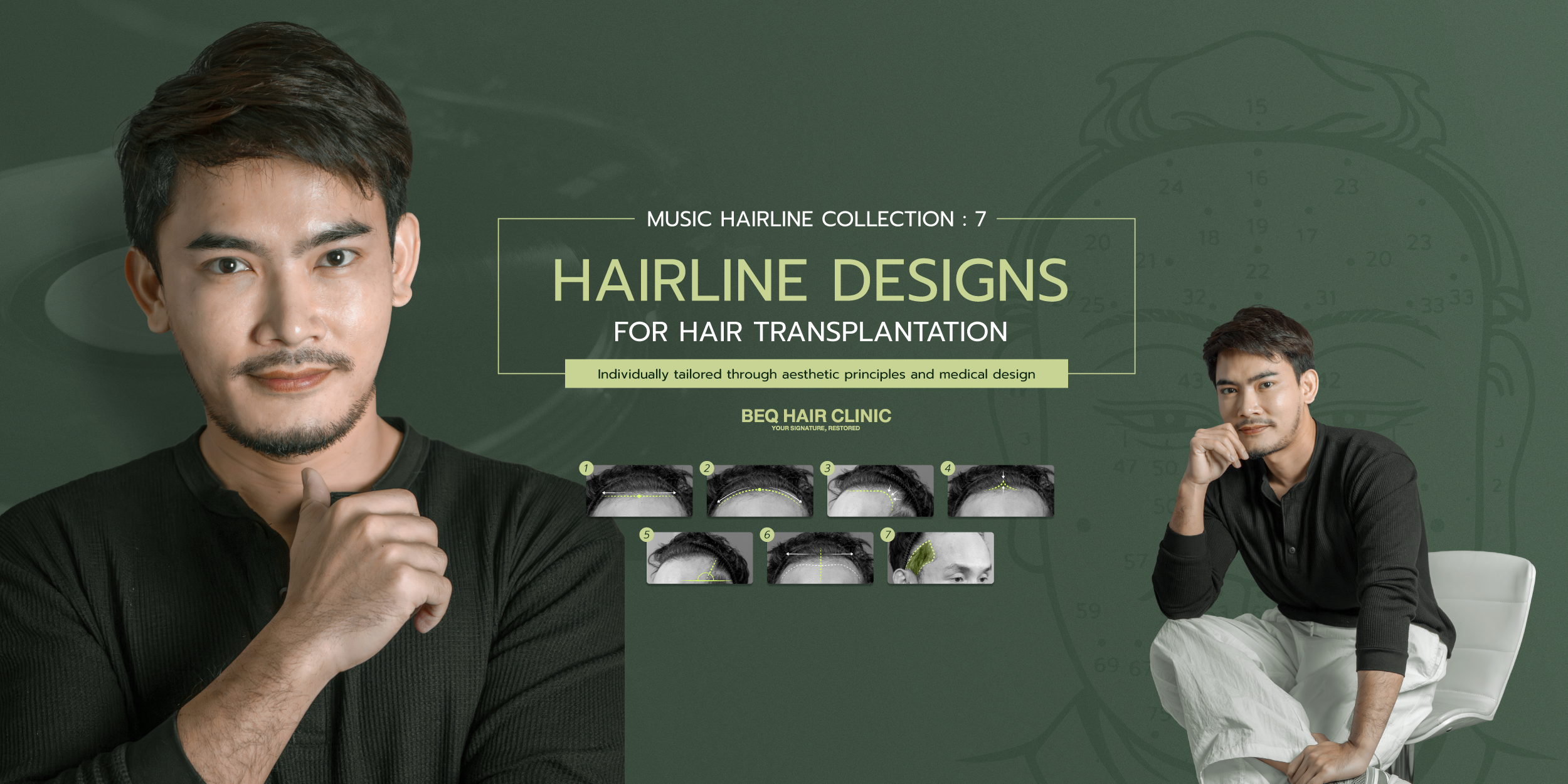
Discover the seven male hairline styles in the MUSIC HAIRLINE COLLECTION, together with the principles of Hairline Geometry and the medical factors assessed before hair transplantation to create a natural-looking hairline that reflects each individual’s distinctive identity.
From Personality to Geometry: When Personal Identity Becomes Hairline Design
Two men may have equally high foreheads yet require very different hairline designs. Hairline restoration is not simply a matter of filling the frontal scalp. Appropriate design must take into account facial proportions, the image or personality the individual wishes to convey, the pre-existing hairline, and the likelihood of future hair loss.
BEQ Hair Clinic therefore developed the MUSIC HAIRLINE COLLECTION, inspired by the character of different musical genres, as a communication framework for describing the form and identity of each hairline style. It is not a medical classification system, nor does it imply that a particular personality type must receive a particular hairline. In clinical practice, every design must be individualized according to anatomy, hair characteristics, and the medical suitability of the patient.
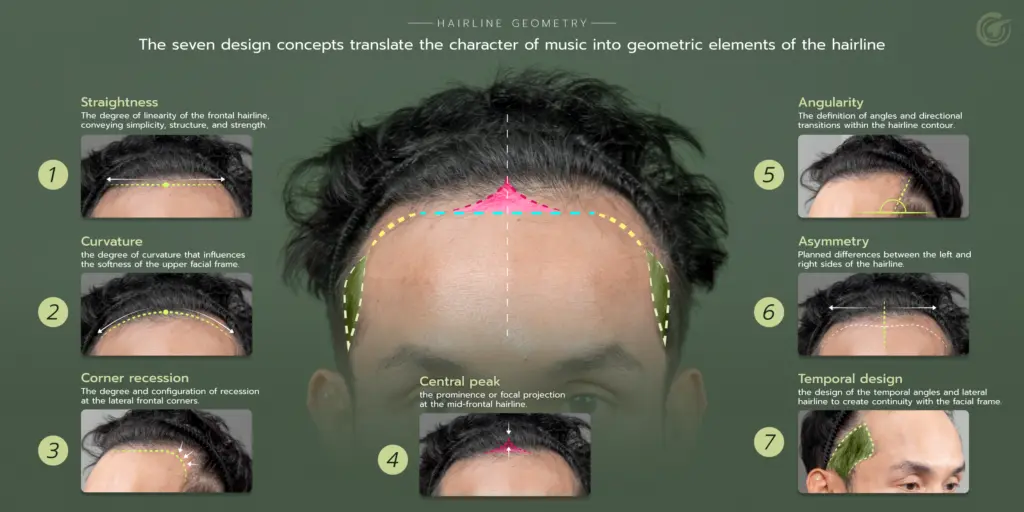
The seven design concepts translate the character of music into geometric elements of the hairline, or Hairline Geometry, including:
- Straightness: the degree of linearity of the frontal hairline, conveying simplicity, structure, and strength.
- Curvature: the degree of curvature that influences the softness of the upper facial frame.
- Corner Recession: the degree and configuration of recession at the lateral frontal corners.
- Central Peak: the prominence or focal projection at the mid-frontal hairline.
- Angularity: the definition of angles and directional transitions within the hairline contour.
- Asymmetry: planned differences between the left and right sides of the hairline.
- Temporal Design: the design of the temporal angles and lateral hairline to create continuity with the facial frame.
These elements form part of natural hairline design and require both an understanding of craniofacial anatomy and technical expertise in hair restoration surgery.
Seven Male Hairline Styles: Which Design May Suit You?
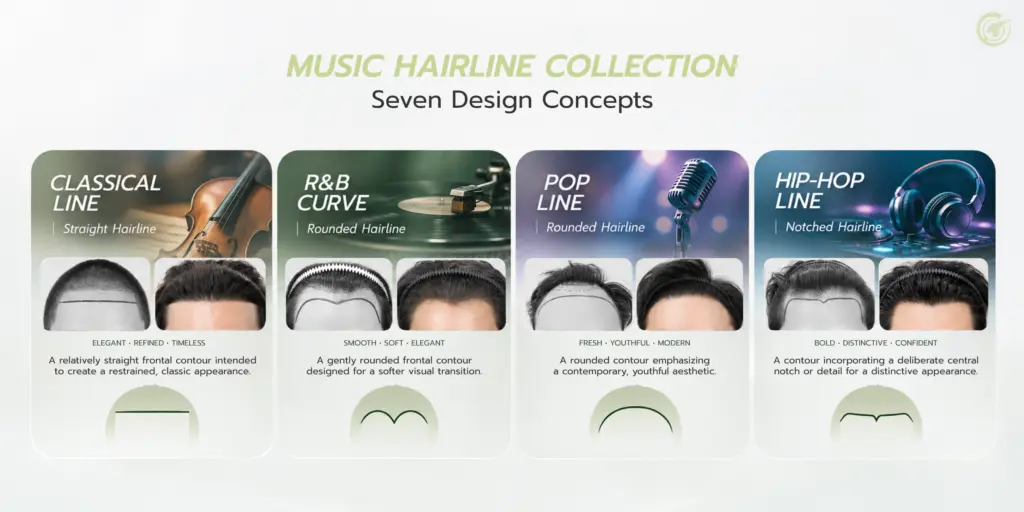

1. CLASSICAL LINE – Refined, Balanced, and Timeless
Balanced Proportion | Refined Structure | Timeless
CLASSICAL LINE is more than a straight hairline. It is a design centered on overall balance, with a restrained, orderly structure that is elegant without being visually excessive. It is suited to men who want a well-defined facial frame without making the hairline itself the dominant feature.
Geometry: A relatively straight frontal contour with only mild curvature, softly defined frontal corners, and gradual transitions in level and direction.
Image & Personality: Creates a polished, refined, mature appearance. It is suitable for individuals who prefer a classic aesthetic and a professional look that remains appropriate across different settings without relying on short-lived trends.
Facial shapes to consider: Oval, square, and proportionately balanced long faces, with additional assessment of forehead height and facial width.
Medical Design: The physician evaluates hairline level, the balance between the mid-frontal point and the frontotemporal corners, and the patient’s existing hairline. A rigid ruler-straight line should be avoided because natural hairlines contain subtle micro-irregularities.
Clinical considerations: In patients with a long face and a high forehead, the hairline level should be planned carefully to avoid further elongating the facial proportions. In patients with a square face or broad jaw, forehead width, temporal contour, and overall facial definition should be assessed together.
2. R&B CURVE – Flowing, Soft, and Elegant
Smooth Curvature | Modern | Soft Elegance
R&B CURVE softens a strong facial frame through a continuous, flowing curve. It is suited to men seeking a softer, contemporary, and approachable appearance without necessarily lowering the frontal hairline excessively.
Geometry: Emphasizes continuous curvature and a smooth connection between the frontal hairline and the temporal region, minimizing abrupt angular transitions.
Image & Personality: Conveys warmth, fluidity, charm, and ease. It is suitable for those who want to soften a strong facial frame while maintaining a modern and distinctly masculine appearance.
Facial shapes to consider: Long, square, and diamond-shaped faces, particularly when a softer upper facial contour is desired.
Medical Design: The physician must coordinate the degree of curvature, hairline height, and frontotemporal angle, while also planning the direction and angle of implantation so that the transplanted hairs blend naturally with the existing hair.
Clinical considerations: In patients with a round face, an excessively rounded or excessively low hairline may visually shorten the face. Final suitability depends on the individual’s actual proportions rather than the name of the face shape alone.
3. POP LINE – Fresh, Clean, and Youthful
Moderate Curve | Fresh | Youthful | Clean
Although POP LINE and R&B CURVE both incorporate curvature, their visual objectives are distinct. R&B emphasizes fluidity and elegance, whereas POP LINE emphasizes freshness, approachability, and a contemporary clean aesthetic without becoming overly soft or rounded.
Geometry: Uses moderate curvature with a clean contour, subtle dimensionality, and limited emphasis on sharp angles.
Image & Personality: Creates a bright, energetic, friendly, and youthful appearance. It is suited to individuals seeking a clean, modern, lively look that does not appear overly formal.
Facial shapes to consider: Oval and long faces, as well as patients with a broad forehead, with the hairline height and width adjusted to individual facial proportions.
Medical Design: The physician must consider age, the projected progression of hair loss, donor-area capacity, and the available graft supply. A youthful appearance does not necessarily require the lowest possible hairline.
Clinical considerations: Round and heart-shaped faces require careful evaluation of the frontal and temporal regions to avoid unintentionally shortening the facial frame or accentuating forehead width.
4. HIP-HOP LINE – Distinctive, Memorable, and Confident
Distinctive Feature | Bold | Confident
HIP-HOP LINE is designed for men seeking a distinctive visual identity. It incorporates one or more clearly recognizable features, such as a controlled notch, an angular feature, or a central peak. However, distinction should arise from anatomy-based design rather than from creating artificial-looking irregularities that appear drawn onto the scalp.
Geometry: One or more focal features are deliberately positioned and proportioned, with their size and location balanced against the surrounding hairline contour.
Image & Personality: Conveys confidence, individuality, expressiveness, and a willingness to stand out. It is suited to those who prefer a bold look with recognizable character and carefully chosen distinguishing details.
Facial shapes to consider: Square and oval faces, and patients with well-defined facial structure, with the design adjusted according to forehead width and the pre-existing hairline.
Medical Design: The physician evaluates the position of the central peak, the degree of corner recession, and the density along the leading edge of the hairline. Appropriate graft selection and the use of single-hair follicular units at the anterior border are important for minimizing an overly rigid or artificial appearance.
Clinical considerations: Patients with a high forehead and long facial proportions should avoid focal features that visually accentuate the vertical length of the forehead.
5. JAZZ LINE – Natural, Rhythmic, and Individual
Controlled Irregularity | Natural Movement | Individual Character
JAZZ LINE emphasizes the subtle details that make a hairline appear naturally individual rather than template-driven. Its defining feature is not perfect symmetry, but carefully controlled irregularity that is intentionally designed.
Geometry: Uses an appropriate degree of asymmetry and natural contour movement, with details adapted to the patient’s pre-existing hairline.
Image & Personality: Conveys naturalness, artistry, creativity, and individuality. It is suited to people who do not want a standardized facial frame and who appreciate subtle, natural variation.
Facial shapes to consider: This concept can be adapted to a wide range of facial shapes because it prioritizes individualized design rather than a fixed geometric template.
Medical Design: The physician plans hairline position, hair-growth direction, exit angle, and graft distribution to reproduce natural growth patterns, particularly within the transition zone between the forehead and the denser hair behind the frontal margin.
Clinical considerations: Asymmetry must be structured and intentional rather than random. If a substantial change in forehead proportions is planned, hairline height and width should be established first.
6. EDM LINE – Angular, Sharp, and Contemporary
Angular Geometry | Sharp Transition | Dynamic
EDM LINE differs from HIP-HOP LINE in that it does not rely primarily on a focal signature feature. Instead, it emphasizes angular geometry and directional transitions between hairline components, such as the frontal corners and temporal angles, to create a structured, sharply defined appearance.
Geometry: Emphasizes clear angular definition and directional transitions while maintaining proportional continuity between the frontal hairline and the temporal region.
Image & Personality: Creates a modern, sleek, energetic, and confident impression. It is suited to individuals who prefer defined geometry, a fashion-forward aesthetic, and a distinctly structured facial frame.
Facial shapes to consider: Oval and diamond-shaped faces, as well as patients seeking a sharper facial frame, with consideration of cheekbone prominence, forehead proportions, and jaw structure.
Medical Design: The physician must carefully evaluate the frontotemporal angle, hairline height, and natural growth direction in the temporal region. Implantation angles must respect native growth patterns because a sharply defined outline may still appear unnatural if the direction of the transplanted hair is inconsistent with adjacent hair.
Clinical considerations: Patients with a prominent jaw or an already angular square face may benefit from softening selected angles. In long faces, hairline height should be assessed carefully to preserve overall facial balance.
7. ROCK LINE – Strong, Straight, and Masculine
Strong Straightness | Masculine | Powerful
ROCK LINE is the most linear and structurally powerful design in the collection. It is suited to men seeking a strong, confident, distinctly masculine facial frame, with less emphasis on curvature or flowing contour details.
Geometry: A relatively straight, continuous, and structurally defined frontal hairline. Unlike EDM LINE, which emphasizes angular transitions, ROCK LINE derives its visual strength primarily from linearity and overall frontal structure.
Image & Personality: Conveys strength, solidity, energy, and leadership. It is suited to individuals seeking a clearly masculine, confident, and visually assertive appearance.
Facial shapes to consider: Round, square, and oval faces in which a more defined upper facial frame is desired; actual facial proportions must always be assessed before selecting the final design.
Medical Design: The physician must control the degree of straightness so that the hairline does not become a rigid geometric line. The transition zone should be refined and natural, and density planning must remain appropriate for the available graft supply.
Clinical considerations: Patients with a high forehead and long face require careful assessment of hairline height. In heart-shaped faces, forehead width and the temporal contour should be considered together.
Medical Hairline Design: What Clinical Parameters Are Used to Design All Seven Styles?
Although the MUSIC HAIRLINE COLLECTION begins with personality and aesthetic style, clinical application requires medical assessment. The following parameters are used to support practical hairline analysis and planning:
1. Hairline Height
The distance from the glabella (the midline point between the eyebrows) to the mid-frontal point (MFP), the most anterior central point of the planned hairline. This measurement contributes to the assessment of frontal hairline height.
2. Corner Recession
The degree of recession at the lateral frontal hairline corners.
3. Central Peak
The prominence of the central projection at the mid-frontal hairline.
4. Asymmetry
The degree of difference between the left and right sides of the hairline.
5. Frontotemporal Angle
The angle formed at the junction between the frontal hairline and the temporal hairline.
6. Temporal Design
Assessment of the temporal hairline and temporal point to plan the continuity between the frontal and lateral hairline in relation to the patient’s facial structure.
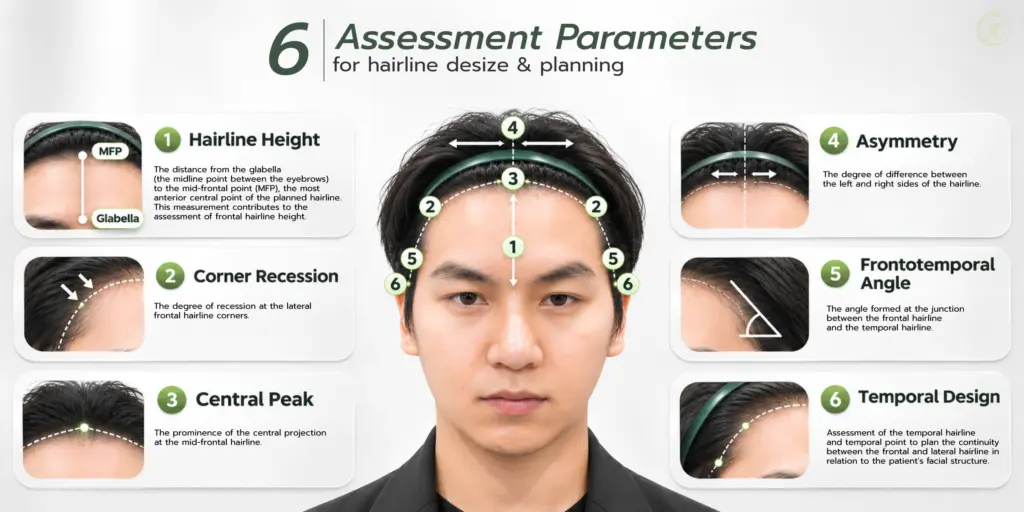
These six assessment parameters are related to the seven Hairline Geometry elements and can be used together to analyze hairline morphology. Curvature, recession, peak prominence, and asymmetry may be categorized as low, medium, or high for comparison between styles. Hairline height and the frontotemporal angle, however, should be assessed using defined anatomic reference points rather than subjective visual grading alone.
Beyond hairline shape, the physician must also consider age, the pattern and expected progression of hair loss, hair characteristics, donor-area capacity, native growth direction, and the number of available grafts. Long-term planning is essential because an excessively low or unnecessarily dense hairline may consume a disproportionate number of grafts and restrict future treatment options as hair loss progresses.
How to Choose the Right Male Hairline for Natural-Looking Results
No single hairline design is appropriate for everyone. The MUSIC HAIRLINE COLLECTION therefore serves as a starting point for identifying an aesthetic style that reflects the individual’s desired image and personality, before adapting that concept to facial anatomy and the medical constraints of each patient.
At BEQ Hair Clinic, physicians assess facial shape, the pre-existing hairline, hair characteristics, donor-area capacity, and the anticipated progression of future hair loss in order to design a natural-looking hairline that remains appropriate over the long term.
You may choose the style that best reflects your identity; the physician’s role is to translate that preferred style into a hairline that is genuinely appropriate for you.
For individualized hairline design, patients may schedule a consultation at BEQ Hair Clinic for medical assessment and personalized hair-transplant planning:
📞 094-441-4965
📩 Line: @beq_haircenter
Click: http://line.me/ti/p/@beq_haircenter
Facebook: BEQ Hair Center
Instagram: beqhaircenter_dr.danai
Instagram: beq_hairclinic
YouTube: BEQ Hair Center
TIKTOK: beq_hair_center