Could cellular ageing represent another layer in the pathogenesis of AGA?
Androgenetic alopecia (AGA) is the most common form of hair loss. Its defining features include progressive miniaturization of hair follicles and disruption of the hair growth cycle, during which terminal hairs gradually become vellus-like hairs and may eventually disappear. Genetic predisposition and androgen activity, particularly that of dihydrotestosterone (DHT), remain central to the pathogenesis of AGA. However, increasingly detailed investigations suggest that cellular senescence may also be associated with the development of AGA.
One reason for this interest is the increasing prevalence of AGA with age, although the condition is by no means confined to older adults. Both AGA and senescent alopecia involve follicular miniaturization and changes in the hair cycle, notably a shortened anagen phase and a prolonged telogen phase. This raises an important question: how might biological ageing within the hair follicle interact with androgen sensitivity?
What Is Cellular Senescence?
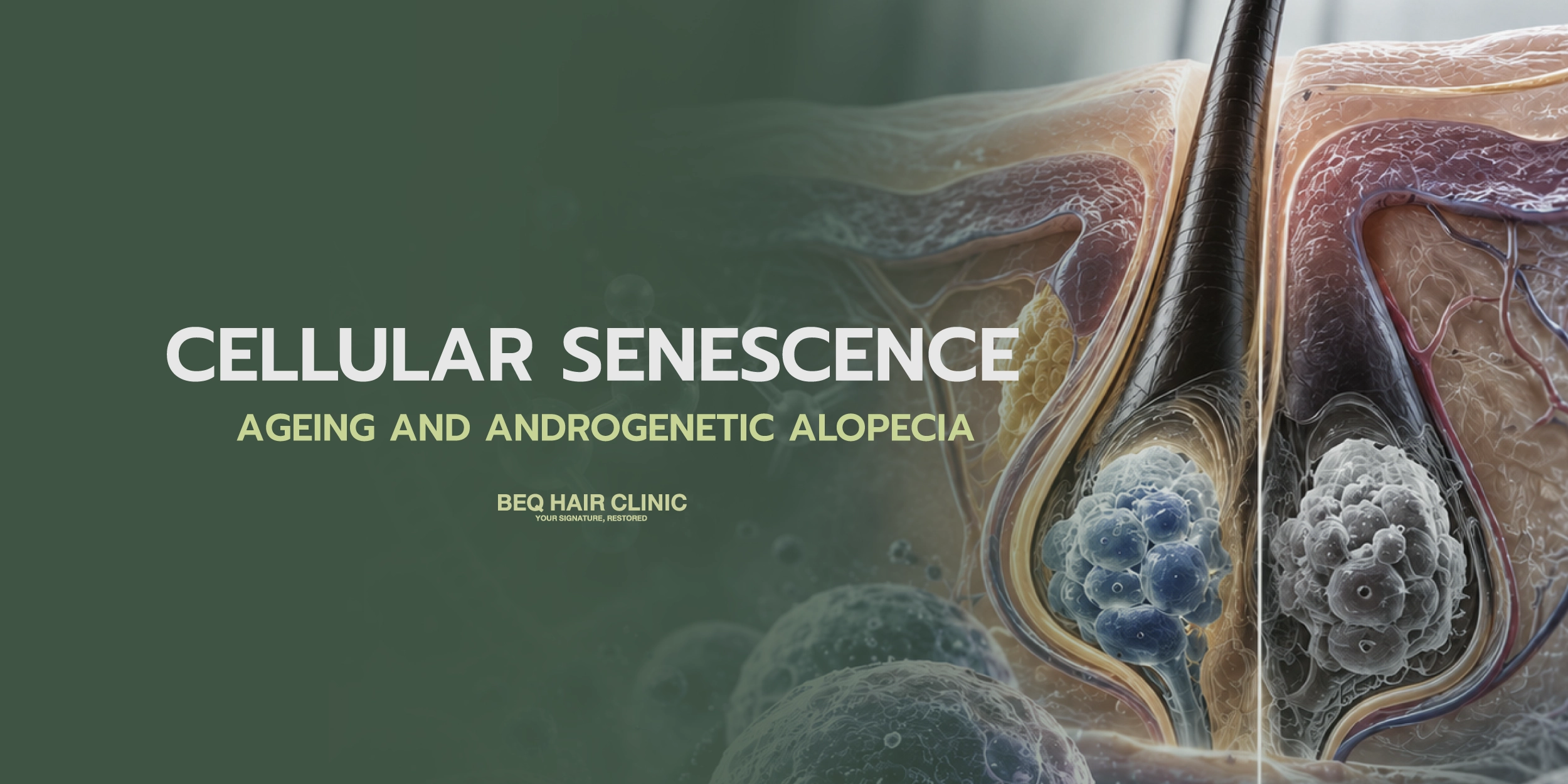
Cellular senescence is a cell fate that may arise in response to damage or stress, including telomere damage, DNA damage and mitochondrial dysfunction. Senescent cells do not immediately die. Instead, they enter a relatively stable state of growth arrest accompanied by metabolic changes, resistance to apoptosis and an altered secretory phenotype.
Importantly, senescent cells are not simply “old cells that have stopped dividing.” They can release cytokines, chemokines, growth factors and matrix-modifying molecules, collectively termed the senescence-associated secretory phenotype (SASP). These mediators can alter the local microenvironment and influence neighbouring cells. Consequently, the effects of senescence extend beyond individual cells to the tissue level.
This is particularly relevant to hair follicles, where hair growth depends on communication among several cell populations, especially dermal papilla cells (DPCs), matrix keratinocytes and hair follicle stem cells (HFSCs). If cells that serve as signalling centres undergo phenotypic changes, regulation of the hair cycle and regenerative signalling may also be affected.
Dermal Papilla Cells: Evidence of Premature Senescence in Balding Scalp
The dermal papilla is a mesenchymal signalling centre at the base of the hair follicle and plays a critical role in regulating hair growth. Studies have reported that DPCs obtained from balding scalp in men with AGA display features of premature senescence in vitro more readily than DPCs from non-balding scalp. Balding DPCs show reduced proliferative capacity and develop a senescent phenotype earlier, whereas non-balding DPCs generally require more culture passages before exhibiting comparable changes. Investigators have identified markers associated with cellular senescence and cell-cycle regulation, including p16INK4a/pRb, alongside changes in inflammatory mediators such as interleukin-6 (IL-6).
These observations do not necessarily establish that DPCs in balding areas are simply “older.” Rather, they suggest that DPCs in androgen-sensitive scalp may have a different biological vulnerability from those in the occipital scalp and may lose their hair growth–supporting capacity earlier. Nevertheless, the association of senescence-related markers with AGA does not demonstrate that cellular senescence alone causes the condition.
How Are Androgens and the Androgen Receptor Related to Cellular Senescence?
DHT is a key androgen in AGA. It binds to the androgen receptor (AR) and modifies gene transcription in DPCs. AR sensitivity and distribution vary across anatomical sites, helping to explain why androgens can stimulate hair growth in some body regions while being associated with follicular miniaturization in the frontotemporal scalp and vertex of genetically susceptible individuals.
Research has linked AR expression with senescence-associated phenotypes in DPCs. Increased AR expression has been observed alongside markers of cellular senescence in AGA, and some experimental findings suggest that androgen exposure can induce senescence-associated changes in DPCs.
The emerging concept is therefore more complex than “DHT causes hair thinning.” Chronic androgen signalling in susceptible follicles may progressively alter the functional state of DPCs, particularly in the presence of oxidative stress and cellular damage. As DPCs lose proliferative or signalling capacity, these changes may accumulate across successive hair cycles and contribute to progressive miniaturization. This remains a mechanistic hypothesis requiring further evidence, especially from human studies.
Oxidative Stress: A Potential Link Between Ageing and AGA
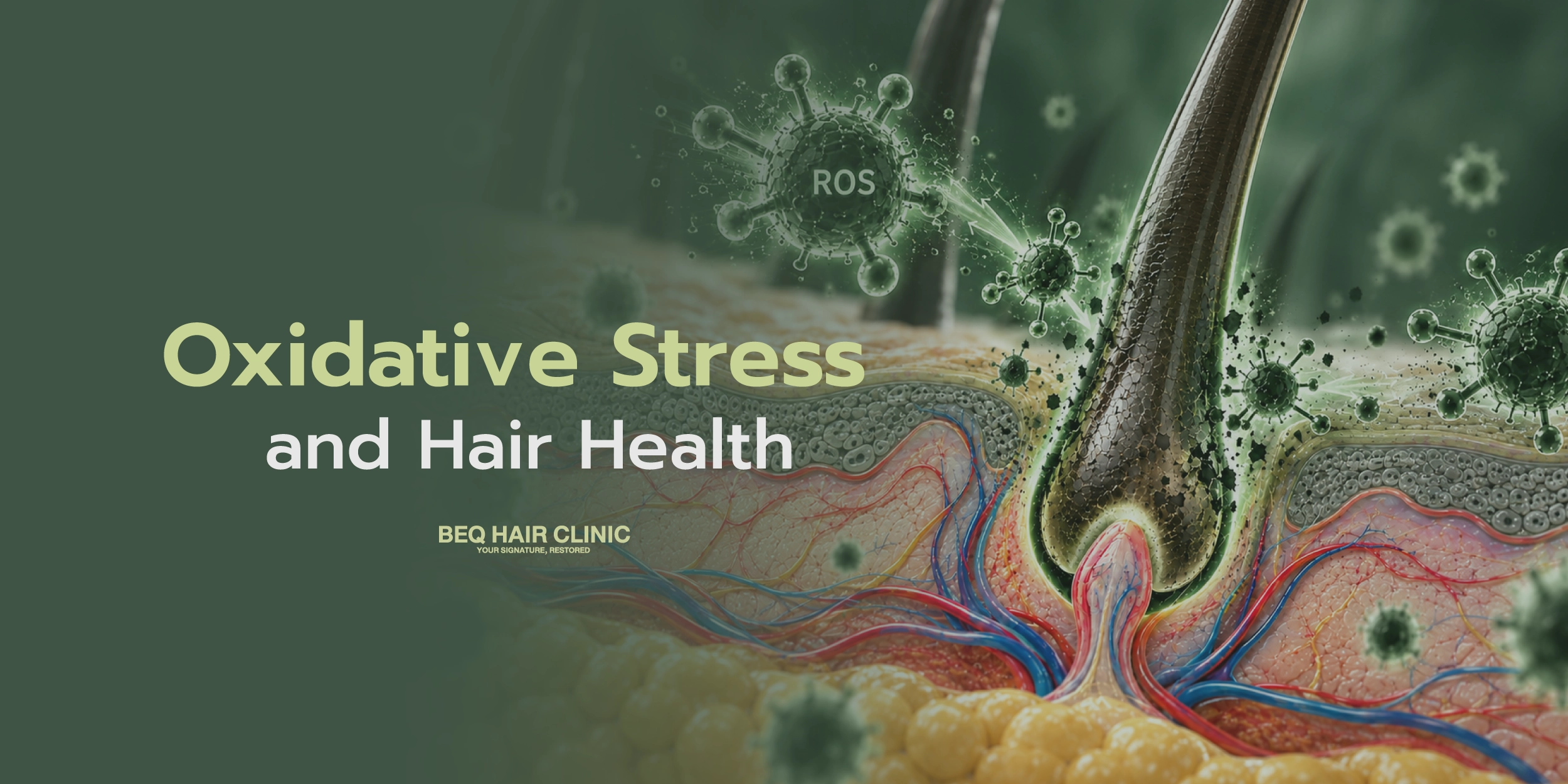
Oxidative stress is frequently proposed as a link between ageing and AGA. Under normal conditions, mitochondria and other metabolic processes generate reactive oxygen species (ROS), which also serve useful signalling functions at appropriate concentrations. When ROS production exceeds antioxidant defence capacity, however, oxidative stress can develop, potentially damaging DNA, proteins, lipids and mitochondria.
Hair-related research indicates that oxidative stress can accelerate entry into catagen, inhibit hair growth and increase apoptosis of follicular keratinocytes in a dose-dependent manner. DPCs from balding scalp have also shown increased markers associated with oxidative stress and DNA damage, including HSP-27, catalase, ATM and ATR.
Balding DPCs also appear more susceptible to oxidative stress than their non-balding counterparts. Sustained ROS accumulation may promote premature senescence and alter cellular secretion in ways that are less supportive of hair growth. Oxidative stress may therefore act not as the sole direct cause of AGA, but as an amplifier that reduces the resilience of androgen-sensitive follicles, particularly when accompanied by mitochondrial dysfunction, DNA damage and senescence.
Hair Follicle Stem Cells and Ageing of the Regenerative Niche
Hair follicle stem cells (HFSCs) reside in the bulge region and are essential for follicular regeneration during successive hair cycles. An important observation in AGA is that follicles can continue cycling and the stem-cell reservoir is not necessarily completely lost, even as regenerative output declines. The newly produced follicles become smaller, anagen becomes shorter and the resulting hairs become finer.
Research on hair ageing indicates that HFSC ageing can reduce regenerative capacity. DNA damage and disturbances in the stem-cell niche may drive HFSCs towards terminal epidermal differentiation, gradually depleting the pool of functional stem cells. Another proposed mechanism involves a reduction in collagen XVII (COL17A1), which helps maintain the HFSC niche. Increased DNA-damage responses and COL17A1 proteolysis may lead to the loss of HFSCs from the niche through terminal differentiation and contribute to progressive follicular miniaturization.
Much of this evidence, however, comes from research into ageing biology rather than AGA specifically. It supports the biological plausibility that stem-cell senescence or niche deterioration could contribute to AGA, but studies directly establishing a causal relationship in AGA are still needed.
SASP: How Senescent Cells May Alter the Hair Follicle Microenvironment
The senescence-associated secretory phenotype (SASP) is another reason cellular senescence has attracted attention in AGA research. Senescent cells can influence surrounding tissues through their secretions. SASP may include pro-inflammatory cytokines, chemokines, growth-regulatory molecules and proteases that affect neighbouring cells and the tissue microenvironment.
If DPCs or other cells within the follicular niche develop an altered SASP, epithelial–mesenchymal communication—an essential component of hair-cycle regulation—may be disrupted. In theory, the accumulation of senescent cells could sustain local inflammation and impair regeneration even after the original stressor has diminished. This has prompted interest not only in preventing senescence, but also in modifying SASP or removing senescent cells as potential therapeutic approaches. Nevertheless, SASP is highly complex, and no AGA-specific SASP profile has yet been validated for clinical diagnosis or treatment selection.
Is AGA a Pro-Ageing State?
Epidemiological studies have reported associations between premature AGA and certain ageing-related or cardiometabolic conditions, including metabolic syndrome, insulin resistance, diabetes mellitus and hypertension. Associations with prostate cancer have also been investigated. These observations have led to the suggestion that AGA may reflect aspects of a “pro-ageing state,” but they do not establish that AGA can be used to predict an individual’s risk of these diseases.
AGA and biological ageing may share mechanisms such as oxidative stress, DNA damage, mitochondrial dysfunction, chronic inflammatory signalling and cellular senescence. AGA may therefore provide a useful model for studying interactions between endocrine susceptibility and ageing biology in regenerative tissues.
Therapeutic Implications: What If Senescence Contributes to AGA?
If cellular senescence contributes to AGA, potential interventions can be considered at three levels: preventing or delaying senescence in DPCs and HFSCs, eliminating senescent cells, and reducing the effects of SASP. For now, these concepts remain investigational and should not replace established treatments such as finasteride and minoxidil.
The first approach involves addressing upstream drivers, including androgen signalling and oxidative stress. Treatments that reduce androgenic signalling remain important because androgen activity is central to AGA and may be associated with senescence-related phenotypes in DPCs. Reducing oxidative burden may help preserve the cellular environment, although clinical evidence supporting antioxidant supplementation as a direct treatment for AGA remains limited.
Nutritional discussions may include Mediterranean-style dietary patterns and micronutrients involved in endogenous antioxidant systems, such as those supporting superoxide dismutase. However, the fact that a mineral serves as a cofactor for an antioxidant enzyme does not mean that supplementing it will treat AGA in someone without a deficiency. Mechanistic rationale must be distinguished from clinical recommendations.
Another research direction involves senolytics, which aim to eliminate senescent cells. Quercetin has been discussed in this context, while experimental compounds such as cyanidin 3-O-arabinoside, arctiin and troxerutin have shown effects on mitochondrial ROS or senescence-associated changes in DPC models exposed to DHT or oxidative stress.
Crucially, most of these findings come from cell-culture or animal models. Describing these compounds as established “AGA treatments” would exceed the available evidence. They nevertheless highlight cellular senescence as a potentially valuable target for future research.
A further strategy is to attenuate SASP or modify the senescent phenotype without necessarily killing the affected cells. If future research can identify pathogenic cell populations and validate biomarkers of senescence burden within hair follicles, AGA management may eventually evolve beyond targeting DHT alone towards precision combination approaches that address both androgen sensitivity and follicular regenerative health.
What We Know—and What Remains Uncertain
Although evidence linking cellular senescence with AGA is growing, important questions remain unanswered. We know that balding DPCs can display senescence-associated phenotypes and greater susceptibility to oxidative stress. Experimental studies link androgen exposure and ROS with cellular senescence, while ageing research demonstrates that HFSC dysfunction can diminish follicular regenerative capacity.
What remains unclear is the extent to which senescence is a primary driver of AGA rather than a consequence of chronic androgen-related injury. There is no validated clinical biomarker for measuring senescence burden in the scalp, and human trials have not yet established that eliminating senescent cells or suppressing SASP can alter the natural history of AGA.
Cellular senescence should therefore be viewed as an emerging layer of AGA pathogenesis that expands our understanding, rather than a new explanation that overturns the established androgen–genetic model.
Conclusion
The scientific understanding of AGA is expanding from a model centred on genetics and androgens to one that also considers ageing biology, oxidative stress and cellular senescence. DPCs from balding scalp exhibit features of premature senescence and increased sensitivity to oxidative stress, while research on hair ageing suggests that HFSC dysfunction and deterioration of the regenerative niche can reduce the capacity of follicles to regenerate.
These insights suggest that future treatment strategies may aim not only to reduce DHT activity or stimulate hair growth, but also to preserve the biological health of follicles, limit cellular stress and protect regenerative potential. Anti-senescence interventions, senolytics and SASP-targeted therapies, however, remain at the research stage.
The most important contribution of this work is not a definitive claim that “senescence is the new cause of AGA.” Instead, it poses a more precise question: how do androgen-sensitive follicles progressively lose their regenerative capacity through cellular ageing, and can that process be prevented?
Reference
Deng Y, Wang M, He Y, Liu F, Chen L, Xiong X. Cellular Senescence: Ageing and Androgenetic Alopecia. Dermatology. 2023;239(4):533–541. doi:10.1159/000530681. PMID:
If you are interested in a hair transplant, or if you have concerns regarding the health of your hair or scalp, please feel free to contact us for further information:
📞 094-441-4965
📩 Line: @beq_haircenter
Click: http://line.me/ti/p/@beq_haircenter
Facebook: BEQ Hair Center
Instagram: beqhaircenter_dr.danai
Instagram: beq_hairclinic
Youtube: BEQ Hair Center
TIKTOK: beq_hair_center