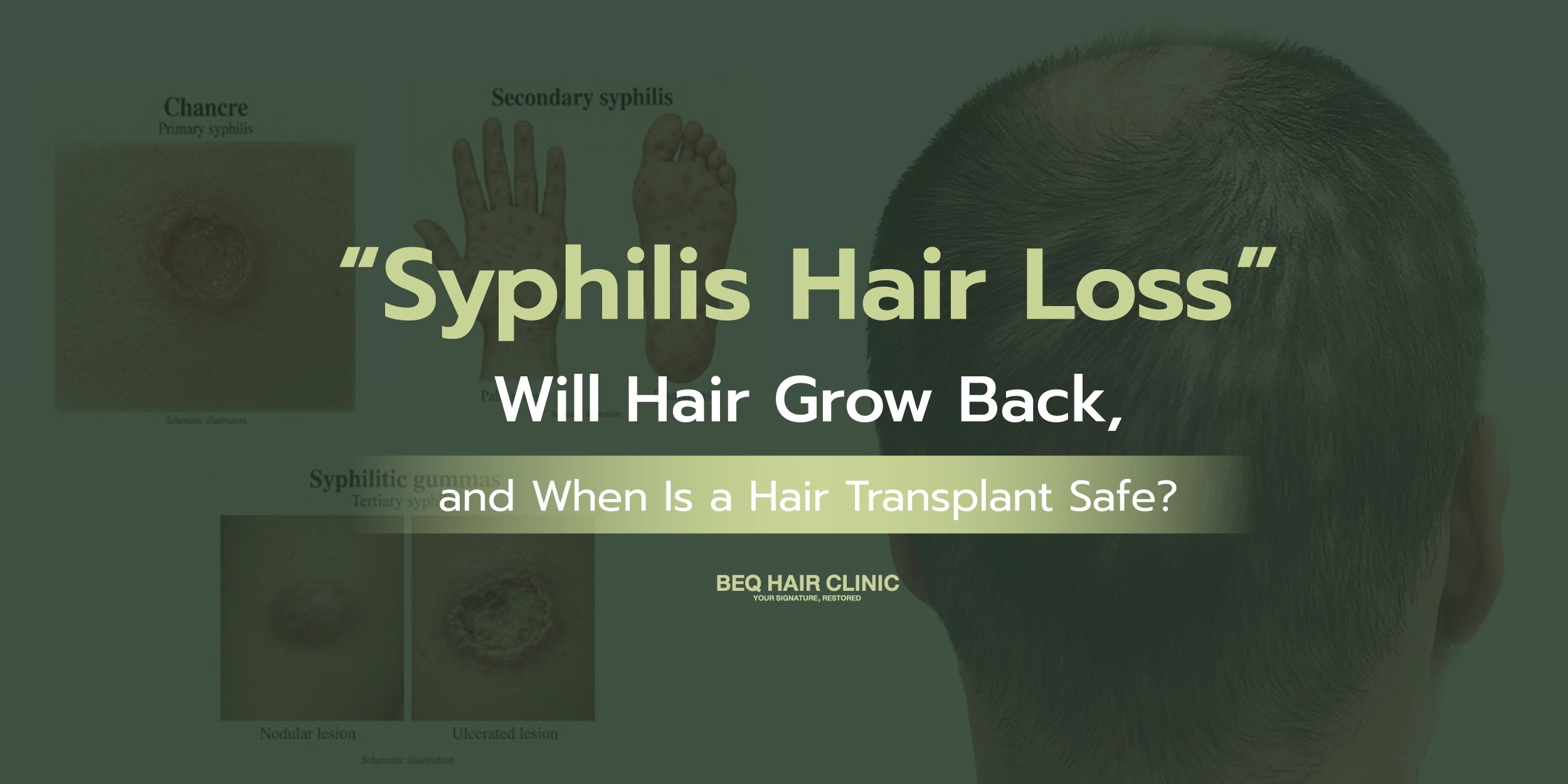
Syphilis is an infectious disease that can cause patchy hair loss, diffuse thinning, or other unusual patterns of hair shedding, particularly during secondary syphilis. This condition is known as syphilitic alopecia.
Although hair loss associated with syphilis often improves following appropriate treatment of the infection, some individuals may also experience hereditary hair thinning, baldness, or a receding hairline that requires additional management, potentially including hair transplantation.
This raises two important questions: Can individuals with current or previously treated syphilis undergo hair transplantation, and when might DHIv Hair Transplantation be considered?
This article explores the causes, diagnosis, treatment, and recovery of syphilitic alopecia, as well as the medical assessment required before hair transplantation and the DHIv option available at BEQ Hair Clinic for patients with a history of infectious disease.
What Is Syphilis, and Why Can It Cause Hair Loss?
Syphilis is an infection caused by the bacterium Treponema pallidum. It is primarily transmitted through direct contact with an infectious lesion during sexual activity and can also be passed from a pregnant individual to the fetus.
The infection is classified into several stages:
- Primary syphilis: Typically causes a sore at the site of infection, which may be painless.
- Secondary syphilis: May cause a rash, swollen lymph nodes, and hair loss.
- Latent syphilis: Has no obvious clinical symptoms, although blood tests may show evidence of infection.
- Tertiary syphilis: Can cause damage to various organs if the infection is left untreated.
Syphilitic alopecia is most commonly associated with secondary syphilis. Infection-related processes may interfere with normal hair follicle function and the hair growth cycle.
Neurological, ocular, or ear involvement can occur at different stages of syphilis. Anyone experiencing visual changes, hearing abnormalities, or neurological symptoms should seek prompt medical evaluation.
What Does Syphilitic Hair Loss Look Like?
Syphilitic alopecia is relatively uncommon and may present in several patterns.
1. Moth-Eaten Alopecia
This pattern consists of small, irregular patches of hair loss scattered across the scalp, sometimes particularly noticeable in the occipital or lateral regions.
2. Diffuse Alopecia
Hair density decreases more generally across the scalp without clearly defined bald patches. This pattern may resemble other forms of shedding, including telogen effluvium.
3. Mixed-Pattern Alopecia
Some patients develop both irregular patches of hair loss and more widespread thinning.
Hair loss may occasionally occur without an obvious rash or other recognizable symptoms of syphilis. This presentation is referred to as essential syphilitic alopecia. However, patchy hair loss does not necessarily indicate syphilis, as several other conditions can produce similar findings.
How Is Syphilitic Alopecia Different from Alopecia Areata?
Syphilitic alopecia can resemble alopecia areata, an autoimmune disorder characterized by patchy hair loss. Physicians may use trichoscopy, a magnified examination of the hair and scalp, to help distinguish the conditions.
A comparative study by Tejapira and colleagues found that exclamation mark hairs supported a diagnosis of alopecia areata, whereas scalp erythema was more frequent among the patients with syphilitic alopecia included in the study.
Trichoscopy alone cannot confirm syphilis. Diagnosis requires consideration of the patient’s medical history, clinical examination, and appropriate blood tests.
Blood Tests Used to Diagnose Syphilis
Syphilis testing generally involves two complementary categories of blood tests:
1. Nontreponemal Tests
Tests such as the rapid plasma reagin (RPR) and Venereal Disease Research Laboratory (VDRL) tests help support diagnosis and monitor response to treatment through changes in antibody titers.
2. Treponemal Tests
These include the Treponema pallidum particle agglutination assay (TP-PA) and other tests detecting antibodies specific to the organism.
Importantly, treponemal tests may remain positive for many years—or for life—even after successful treatment. A positive result therefore does not always indicate an active infection.
Physicians must interpret test results alongside treatment history, symptoms, RPR or VDRL titers, and the possibility of reinfection. For patients considering hair transplantation, a single positive test should not, by itself, determine whether surgery is appropriate.
How Is Syphilitic Hair Loss Treated?
The priority is to treat the underlying syphilis infection according to its stage, rather than proceeding directly to hair transplantation.
For adults with uncomplicated primary or secondary syphilis, the US Centers for Disease Control and Prevention (CDC) recommends a single intramuscular dose of 2.4 million units of benzathine penicillin G.
However, the appropriate regimen and duration depend on the stage of infection, associated complications, pregnancy status, and any history of drug allergy. Patients should not self-medicate or select antibiotic treatment based solely on hair loss.
A Jarisch–Herxheimer reaction may occur within 24 hours after treatment begins, causing symptoms such as fever, chills, headache, or muscle pain. This reaction should be distinguished from a medication allergy. Pregnant patients or anyone experiencing severe symptoms should seek prompt medical care.
Will Hair Grow Back After Syphilis Treatment?
In many cases, hair lost because of syphilis can regrow after appropriate treatment of the infection. Syphilitic alopecia is generally a nonscarring form of hair loss, meaning the follicles often retain the capacity to produce hair.
Medical reports describe visible regrowth in some patients within approximately three months, with further improvement over three to six months. Recovery time and final hair density vary between individuals.
If thinning, baldness, or a receding hairline persists after syphilis treatment, another contributing condition may be present, such as:
- Androgenetic alopecia (hereditary pattern hair loss)
- Telogen effluvium
- Alopecia areata
- Nutritional deficiencies or certain underlying medical conditions
- Scalp disorders affecting the hair follicles
In particular, treating syphilis alone may not restore full density in someone who also has androgenetic alopecia. Depending on the diagnosis, a physician may recommend medical treatment or consider hair transplantation when indicated.
Can Someone with Current or Previously Treated Syphilis Have a Hair Transplant?
Individuals with a history of syphilis can undergo assessment for hair transplantation, but this does not mean that surgery is immediately appropriate for every patient.
When hair loss is directly caused by syphilis, the infection should be treated and natural regrowth monitored first, since transplantation may not be necessary.
If syphilis has been appropriately treated but hereditary thinning, baldness, or hairline recession persists, hair transplantation may be considered. The physician will assess infection status, treatment history, general health, scalp condition, and the quality of hair in the donor area.
How Long Should You Wait After Syphilis Treatment Before a Hair Transplant?
There is currently no single, universally established waiting period for hair transplantation following syphilis treatment.
The physician will consider whether treatment was appropriate, whether there is evidence of ongoing infection or reinfection, and how much the hair affected by syphilis has recovered.
A negative treponemal test is not always required, as these tests may remain positive after successful treatment. If syphilis has not been treated or the infection status remains uncertain, elective transplantation should be deferred until appropriate medical evaluation has been completed.
DHIv Hair Transplantation: An Option for Patients with a History of Syphilis
Some individuals who have completed appropriate treatment for syphilis continue to experience hereditary thinning, baldness, or hairline recession for unrelated reasons and may wish to restore hair density or improve their hairline.
A common concern is whether a previous infection prevents transplantation or requires a particular surgical technique.
BEQ Hair Clinic offers DHIv Hair Transplantation, a technique developed with consideration for patients who have coexisting infectious diseases, particularly HIV or hepatitis B or C, and who require appropriate medical assessment and procedural planning.
A similar individualized assessment may be applied to patients with a history of syphilis. The physician will review prior treatment, current disease status, general health, and the cause of hair thinning before deciding whether DHIv is appropriate.
A history of syphilis is not a lifelong contraindication to hair transplantation, nor does it mean that every patient must undergo DHIv. When hair loss is directly related to syphilis, treating the infection and monitoring regrowth should take priority.
What Are the Key Features of DHIv?
1. Small-Diameter Graft Extraction Punches
BEQ Hair Clinic states that DHIv uses extraction punches approximately 0.6–0.8 mm in diameter. The physician selects an appropriate size according to graft characteristics, with the aim of minimizing tissue trauma during extraction.
2. Graft Handling and Preservation
Extracted grafts are sorted, prepared, and stored in an appropriate preservation solution before implantation into the recipient area.
3. Implantation Using a DHI Implanter
The physician uses an implantation device to guide graft placement, orientation, and angle in accordance with the planned hairline design.
4. Infection Prevention and Control
BEQ Hair Clinic emphasizes appropriate instrument preparation, intraoperative handling, and infection-control measures in accordance with medical standards. These precautions must be applied appropriately to every patient.
5. Individualized Preoperative Assessment
For patients with previously treated syphilis, the physician reviews treatment history, relevant blood test results, and disease status, together with scalp and donor-area assessments, to plan suitable care.
Is DHIv Suitable for Someone Who Has Previously Had Syphilis?
A person with previously treated syphilis who continues to experience hair thinning may be assessed for DHIv transplantation if there is a valid indication for surgery and the patient is medically fit.
DHIv does not treat syphilis. Furthermore, there is currently insufficient evidence to conclude that DHIv produces better outcomes or is safer than other hair transplantation techniques specifically for patients with a history of syphilis.
Why Is a Medical Consultation Important Before Choosing a Technique?
Hair transplantation requires assessment of more than graft numbers or hairline design. For patients with a history of syphilis, the physician must first determine the cause of the current hair loss.
If syphilis is directly responsible, treating the infection and observing hair recovery may be more appropriate. If the patient has hereditary thinning or another form of hair loss for which transplantation is indicated, the physician can consider suitable techniques, including DHIv, based on hair characteristics, scalp condition, and overall health.
At BEQ Hair Clinic, patients may discuss DHIv transplantation with a physician and provide previous syphilis treatment records and blood test results for review. A complete and accurate medical history supports appropriate planning and patient safety.
Frequently Asked Questions About Syphilis, Hair Loss, and DHIv
Does syphilis cause permanent hair loss?
Syphilitic alopecia is generally nonscarring, and hair can often regrow after the infection is treated. Persistent thinning should prompt assessment for other causes.
Can I have a hair transplant if my syphilis has been treated but my hair is still thin?
Possibly. If the infection has been appropriately treated and a physician identifies another cause of hair loss for which transplantation is indicated, surgery may be considered.
Can I have a hair transplant if my syphilis blood test is still positive?
It depends on the type of test, treatment history, and current disease status. A persistently positive treponemal test after treatment does not necessarily mean the infection is still active.
Can DHIv treat hair loss caused by syphilis?
No. DHIv is a hair transplantation technique, not a treatment for syphilis. If the infection itself caused the hair loss, the infection should be treated and regrowth monitored first.
Must everyone with a history of syphilis choose DHIv?
No. A history of syphilis does not automatically indicate DHIv. The physician will recommend an appropriate approach after individual assessment.
Can DHIv also be considered for patients with HIV or hepatitis?
BEQ Hair Clinic offers DHIv as an option for patients with coexisting infections, including HIV and hepatitis B or C. Each patient must undergo an individualized preoperative medical assessment.
A History of Syphilis Does Not Necessarily Rule Out Hair Restoration
Having had syphilis does not automatically mean that hair transplantation is no longer an option. If the infection has been appropriately treated and hair thinning, baldness, or recession persists for another reason, transplantation may be considered following medical assessment.
BEQ Hair Clinic offers DHIv Hair Transplantation, a technique developed with consideration for patients with coexisting infectious diseases, supported by individualized evaluation and treatment planning.
For patients with a history of syphilis, the physician reviews prior treatment, current disease status, general health, and hair and scalp characteristics before determining whether DHIv or another treatment approach is more suitable.
A previous syphilis diagnosis should not, by itself, prevent someone from seeking a medical assessment for appropriate hair restoration.
Book a Medical Consultation at BEQ Hair Clinic
Discuss your hair loss concerns and suitability for DHIv Hair Transplantation with our medical team.
DHIv service information: https://beqclinic.com/service/dhiv/
Facebook: https://www.facebook.com/BEQHairClinic
LINE Official Account: http://line.me/ti/p/@beq_haircenter
WhatsApp: +66 94 441 4965
WeChat: BEQ_HairCenter
References
Centers for Disease Control and Prevention (CDC). Syphilis — STI Treatment Guidelines. https://www.cdc.gov/std/treatment-guidelines/syphilis.htm
CDC. Primary and Secondary Syphilis. https://www.cdc.gov/std/treatment-guidelines/p-and-s-syphilis.htm
CDC. Laboratory Recommendations for Syphilis Testing, United States, 2024. https://www.cdc.gov/mmwr/volumes/73/rr/rr7301a1.htm
CDC. Syphilis Among Persons with HIV Infection. https://www.cdc.gov/std/treatment-guidelines/syphilis-hiv.htm
CDC. Syphilis During Pregnancy. https://www.cdc.gov/std/treatment-guidelines/syphilis-pregnancy.htm
Pomsoong C, et al. Epidemiological, Clinical, and Trichoscopic Features of Syphilitic Alopecia: A Retrospective Analysis and Systematic Review. Frontiers in Medicine. 2022;9:890206. https://doi.org/10.3389/fmed.2022.890206
Tejapira K, et al. Trichoscopic Features of Syphilitic Alopecia and Alopecia Areata: A Comparative Study. Clinical, Cosmetic and Investigational Dermatology. 2023;16:2259–2269. https://doi.org/10.2147/CCID.S424054
BEQ Hair Clinic. DHIv Hair Transplantation. https://beqclinic.com/service/dhiv/
International Society of Hair Restoration Surgery (ISHRS). Patient Information. https://ishrs.org/patients/getting-started/