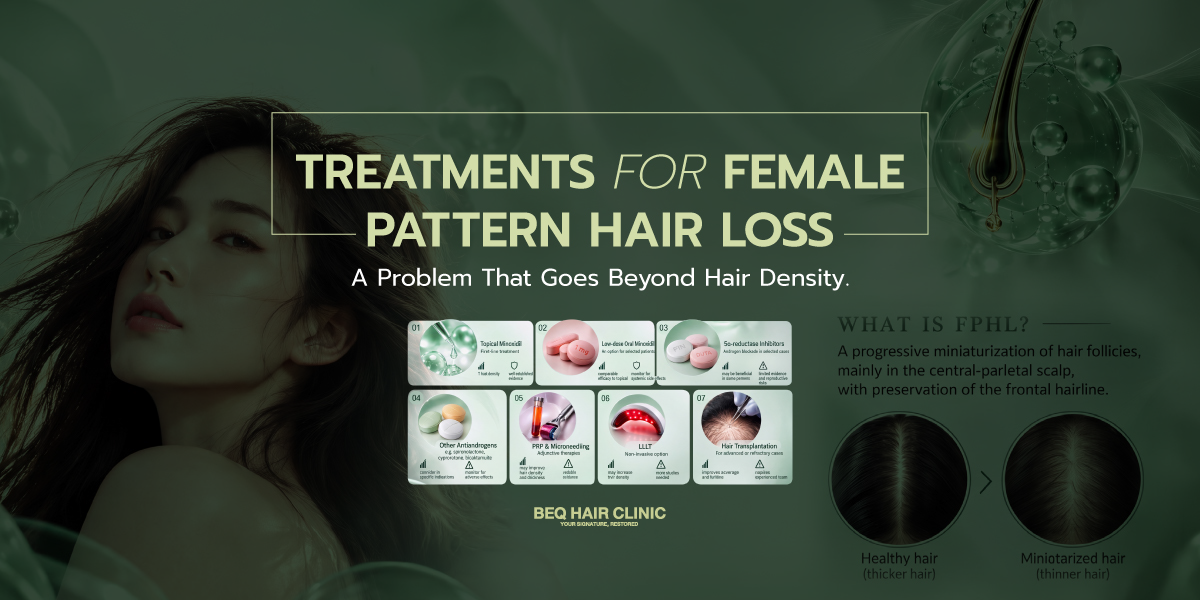
Female Pattern Hair Loss: More Than a Change in Hair Density
Female pattern hair loss (FPHL) is a non-scarring form of alopecia characterized by progressive miniaturization of hair follicles. It typically presents as thinning over the central and parietal scalp, with the frontal hairline generally preserved. Beyond visible hair thinning, FPHL can affect self-image, confidence, and quality of life.
The pathogenesis of FPHL is not yet fully understood. Although genetic susceptibility and androgens may contribute, other hormonal and environmental factors are also implicated. FPHL should therefore not be assumed to follow exactly the same mechanisms as male androgenetic alopecia. Clinical studies also use different endpoints—including hair count, hair density, hair-shaft diameter, photographic assessment, and the Sinclair scale—making direct comparisons of efficacy difficult. Its chronic, progressive nature adds another challenge: treatment and research both require sustained adherence over time.
Topical Minoxidil: First-Line Treatment
Minoxidil was originally developed as a vasodilator for hypertension. Its ability to cause hypertrichosis subsequently led to its use in hair-loss treatment. Its effects extend beyond vasodilation and involve potassium channels, dermal papilla cell proliferation, and follicular signaling. A meta-analysis reported that 2% topical minoxidil applied twice daily increased hair count by an average of 12.4 hairs/cm² compared with placebo after 24 weeks. Once-daily 5% minoxidil also has supportive clinical evidence and may be easier for some patients to maintain over the long term.
Minoxidil is a prodrug that requires conversion to minoxidil sulfate through follicular sulfotransferase activity, including the enzyme encoded by SULT1A1. Adverse effects may include scalp irritation, itching, facial hypertrichosis, and contact dermatitis; the latter may be associated with propylene glycol in certain formulations. Some patients experience temporary shedding when treatment begins, associated with early release of telogen hairs. This possibility should be explained in advance so that patients do not discontinue treatment unnecessarily without medical advice. Response is generally assessed after several months, and continued use is usually necessary to maintain benefits.
Low-Dose Oral Minoxidil: Convenience and Systemic Safety
Low-dose oral minoxidil (LDOM), often used in FPHL at approximately 1.25–2.5 mg/day, is converted to its active sulfate metabolite through hepatic sulfotransferase activity, including SULT2A1. It may be considered when topical treatment causes irritation or is difficult to use consistently. In an open-label randomized study involving 52 women, oral minoxidil 1 mg/day and once-daily 5% topical minoxidil produced improvements in hair density without a statistically significant difference between groups. Another study comparing oral doses of 0.25 and 1 mg/day suggested a dose-response relationship; however, higher doses are not necessarily appropriate for every patient.
Potential adverse effects include hypertrichosis, headache, dizziness, palpitations, and other cardiovascular effects. Although hypotension is relatively uncommon with low doses in normotensive individuals, clinicians must assess underlying conditions and concomitant medications. Oral minoxidil for hair loss is an off-label treatment in many countries. Current evidence does not establish that oral administration is superior to topical treatment for all women.
5α-Reductase Inhibitors: Androgen Blockade in FPHL
Dihydrotestosterone (DHT) is central to male androgenetic alopecia, but the relationship between androgens and FPHL is more complex. Many women with FPHL have no clinical hyperandrogenism. In a controlled study of postmenopausal women, finasteride 1 mg/day did not improve FPHL, whereas some uncontrolled studies using 2.5–5 mg/day reported improvement in selected patients. Adequately powered randomized trials remain insufficient to draw definitive conclusions.
Dutasteride inhibits both type 1 and type 2 5α-reductase and suppresses DHT more strongly than finasteride, but evidence specifically in FPHL remains limited. Greater DHT suppression does not necessarily translate into superior clinical outcomes. Both drugs carry reproductive risks, particularly to a male fetus. Pregnancy potential, effective contraception, and informed consent require careful consideration in women of reproductive age. Their use for FPHL is off-label in many settings.
Variation in response to oral finasteride also underscores that different presentations of female hair loss may not share the same pathophysiology. Clinical evaluation should distinguish earlier, premenopausal onset from later, postmenopausal onset and determine whether hyperandrogenemia is present.
Spironolactone, Cyproterone Acetate, and Bicalutamide
Spironolactone is a potassium-sparing diuretic with androgen-receptor antagonistic activity. It is used in FPHL, particularly when acne, hirsutism, or other signs of hyperandrogenism coexist. High-quality evidence remains limited. Potential adverse effects include fatigue, breast tenderness, menstrual irregularities, hypotension, and hyperkalemia.
Cyproterone acetate has both antiandrogenic and antigonadotropic effects. Some studies suggest that response may vary with the patient’s hyperandrogenic phenotype, although this should not be treated as an absolute prescribing rule. Flutamide is limited by the risk of severe hepatotoxicity. Retrospective studies of bicalutamide have reported improvements in Sinclair scores, but concomitant treatments make it difficult to isolate its independent effect. Hepatic adverse effects remain a concern, and these antiandrogen therapies are not safe during pregnancy.
Prostaglandins, Vitamins, and Nutraceuticals
Prostaglandin analogues such as latanoprost and bimatoprost influence follicular activity and pigmentation. However, evidence for their use in FPHL is limited, and medication costs may restrict their practicality when treating large areas of the scalp.
Patients frequently ask about vitamin D, ferritin, biotin, zinc, saw palmetto, caffeine, melatonin, and botanical extracts. Reports of low micronutrient levels in some groups do not demonstrate that supplementation reverses FPHL in individuals without a documented deficiency. Correcting a clinically significant deficiency may be important, particularly when telogen effluvium is also present. Associations, plausible biological mechanisms, and demonstrated treatment efficacy must be considered separately.
Mesotherapy and Intradermal Therapy
Mesotherapy involves injecting active agents, such as minoxidil or dutasteride, into the scalp. Some studies report photographic improvement or a better terminal-to-vellus hair ratio, but increases in hair density have not consistently exceeded placebo. A major limitation is the lack of standardization in formulation, concentration, injection depth, treatment frequency, and sterile preparation.
Microneedling and Microinfusion of Drugs
Microneedling creates controlled microinjuries intended to activate wound-healing pathways, growth factors, and potentially hair-growth signaling. Improvements have been reported in FPHL, but reviews describe the quality of evidence as low. There is no established consensus on needle depth, treatment endpoints, session frequency, or maintenance schedules.
Microinfusion of drugs into the skin (MMP) uses a tattoo-machine-like device to deliver substances into the superficial dermis. Evidence specific to FPHL remains limited, and clinicians must consider sterility and whether medications are approved for the intended route of administration. It also remains unclear whether repeated microneedling that induces fibrosis could complicate future hair transplantation.
Platelet-Rich Plasma (PRP)
Platelet-rich plasma (PRP) is an autologous platelet concentrate that releases growth factors, including PDGF, VEGF, EGF, and IGF-1. Randomized studies and meta-analyses suggest a potential increase in hair density, although many studies have small samples or incomplete blinding.
PRP preparation differs substantially among clinics in platelet concentration, centrifugation, activation, injection technique, and treatment intervals. Consequently, average results from one study cannot guarantee outcomes for every patient. PRP is a promising adjunct rather than a replacement for first-line therapy, and applicable local regulations should be reviewed.
Botulinum Toxin and Photobiomodulation
Botulinum toxin has been proposed to reduce scalp-muscle tension, influence microcirculation, or modify TGF-β1 signaling. A split-scalp study in men already receiving finasteride and minoxidil reported greater improvement on the treated side than on the saline-control side. However, this is not direct evidence for FPHL, and standardized protocols have not been established.
Photobiomodulation, also called low-level light therapy (LLLT), encompasses a range of laser and LED devices. Some studies report improvements in hair density compared with placebo. However, wavelength, fluence, device design, and treatment duration vary considerably, so results should not be generalized across all devices. LLLT may be considered as an adjunct for appropriately selected patients.
Hair Transplantation: Assessing the Donor Area Is Essential
Hair transplantation is not appropriate for every woman with FPHL because diffuse follicular miniaturization may also affect the donor area. The physician must assess the entire scalp and exclude conditions such as alopecia areata, chronic telogen effluvium, and active scarring alopecia. When donor density is low or donor follicles are extensively miniaturized, transplantation may not achieve a satisfactory cosmetic improvement.
Hair transplantation does not cure FPHL. Ongoing medical management of existing, non-transplanted hair may still be required to limit further progression.
Camouflage and Patient-Centered Care
Beyond medical interventions, cosmetic camouflage can provide meaningful benefits. Options include hair prostheses, hair fibers, concealing sprays, and scalp micropigmentation, which may improve the appearance of density immediately—particularly for patients with advanced thinning or inadequate response to medication. Hair prostheses may use human or synthetic hair and require attention to maintenance, traction, and possible contact dermatitis. Scalp micropigmentation reduces the visual contrast between hair and scalp but carries risks including infection, allergic reactions, and pigment changes.
Offering camouflage is not an admission that treatment has failed. It is a practical, patient-centered way to address visible hair loss and improve quality of life.
Conclusion: Evidence Matters More Than the Number of Treatments
According to the 2023 review on which this article is based, topical minoxidil has the strongest evidence among the medications evaluated. Oral minoxidil, antiandrogens, and many procedural approaches still require better-controlled trials and standardized long-term follow-up. FPHL management should begin with an accurate diagnosis, assessment of severity and donor-hair status, and a balanced discussion of potential benefits and risks. Patients should participate in treatment planning, with progress monitored periodically using standardized photography or trichoscopy.
This article reflects the evidence covered by the 2023 review rather than a comprehensive assessment of all studies published through 2026. Current evidence and applicable regulatory requirements should always be checked before clinical implementation.
Reference
Ramos PM, Melo DF, Radwanski H, Cortez de Almeida RF, Miot HA. Female-pattern hair loss: therapeutic update. Anais Brasileiros de Dermatologia. 2023;98(4):506–519. doi:10.1016/j.abd.2022.09.006.
If you are interested in a hair transplant, or if you have concerns regarding the health of your hair or scalp, please feel free to contact us for further information:
📞 094-441-4965
📩 Line: @beq_haircenter
Click: http://line.me/ti/p/@beq_haircenter
Facebook: BEQ Hair Center
Instagram: beqhaircenter_dr.danai
Instagram: beq_hairclinic
Youtube: BEQ Hair Center
TIKTOK: beq_hair_center